If the title gave you pause to stop reading, please hang with me for a bit.
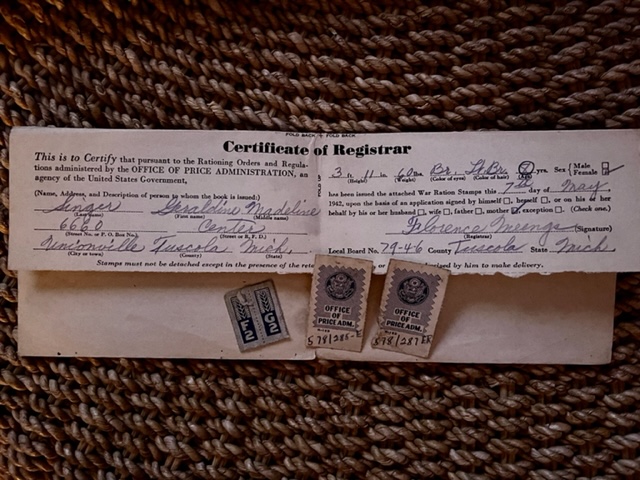
A short while after my mother passed away, I received a package from my cousin in the mail. My mom and her mom (my mom’s sister) passed away within one week of each other. She had been going through her mom’s things, and found a few items of my mother’s. Of interest, there were four War Ration books issued to my mom, who at the time in 1942 was age 9, 3 ft 11 inches tall, and 60 lbs. (according to the information recorded in the book). Issued by the Office of Price Administration, the coupons were to be used for the fair rationing of items that were scarce during the war. Many types of things were rationed: food, coffee, gasoline, tires, shoes, sugar. Items critical to the war effort were mainly what rations were assigned to. It was a fairly complex, color coded, points based system that was ultimately designed to provide for the distribution of these scarce commodities. And with every well intentioned system that is designed, naturally, ill-intended people found a way to circumvent the rules. A black market was created, and hoarding became a key component and unsavory underbelly to this well-intended program. Anything sounding vaguely familiar?

The Price of Gasoline
In the last several weeks, the world has witnessed the most violent attack on democracy that we have seen in decades. Innocent civilians, including children and babies, have been murdered because of the aspirations of a power hungry, megalomaniac dictator. What we are seeing is profoundly and inherently wrong, and with the marvels of modern technology, is literally unfolding before our eyes.
And in the midst of this, hundreds of millions of people around the world are seeing the cost of many commodity items rise. But the most talked about and complained about is the price of gasoline. I have seen so many news stories and social media posts, and have personally partaken in conversations about how people are being individually burdened by the rise in fuel costs.
So I thought I would offer my commentary on the price of gas, what actually drives it (spoiler alert, it’s not the elected government of ANY political party or nation), and then pose a serious question to everyone that is outraged.
Guns vs. Butter – The Basic Dilemma
Most simply, the price of gasoline is driven by supply and demand. When the demand decreases without a corresponding change in supply (think during the early days of the pandemic), prices go down, and vice versa. As travel resumed and restrictions were lifted around the globe, demand increased, and the price of gas began to rise. Pretty common economic principles at play. Now, due to the current geo-political environment, and many countries’ sanctions on Russian goods (including oil), the world supply of oil has been reduced. Each nation is being impacted to some degree, some more than others depending on their overall reliance on Russian oil. So what are the options as it relates to the price of gasoline?
1: Let the Forces of Supply and Demand Work Unassisted
This one is pretty simple. Without any intervention, just let consumer demand (read: OUR choices) drive the price of items relative to the available supply (read: what CORPORATIONS/NATIONS are willing to produce/supply). Often, bad characters will make a bad situation such as this worse, by buying up limited supply and then charging exorbitant rates for products (think The Great Toilet Paper Shortage of 2020). Also, those in control of supply can take advantage of this dynamic, either by keeping prices higher than necessary or holding back supply, resulting in increased profits. Nearly every corporation at some point in their entire existence has done this – that’s called capitalism. If nothing is done to impact demand or supply, you mostly get what you get. Also, just for fun sometime, Google the lifetime contributions to various lawmakers’ campaigns (and these money grabs come from both sides of the aisle) from the fossil fuel industry. Sometimes, a blind eye is turned to the greed. Only campaign finance reform can change this dynamic. That’s an entirely separate discussion.
2: Insert an Artificial Control on Market Forces
There are several forms that this can take. One example (not used in many years) is the rationing that I described earlier. This artificially impacts demand, and thus lowers prices. I am curious if those who are incensed over the price of gasoline would be willing to accept the rationing of gas akin to WWII or during the oil embargo of 1973 to lower prices. Fun Fact: another technique employed in 1973 was to reduce the speed limit to impact fuel consumption – something that drivers could personally choose to do on their own.
Monetary policy is also used to influence prices – you don’t care for inflation and want the government to do something about it? They have the ability to raise interest rates – for those of you asking the government to step in and help, your wish was granted this week. The Federal Reserve Bank raised their benchmark rate for the first time in more than three years. The cost of all borrowing goes up (mortgage rates, credit cards, car loans,etc.) which tends to influence people’s purchases (demand), which then should translate to price adjustments. Another version of market intervention is subsidies. The government in many instances supports via direct payments the prices that producers would be able to garner in the open market for their goods, which in return, keeps the prices lower for the end consumer (you). Did you know that there are times when the government pays farmers NOT to plant crops? If you are opposed to unemployment or welfare, this should also get your hackles up, or at least give you pause to learn about this use of tax-payer dollars.
3: Take a Stake in the Situation
Here’s where the rubber hits the road. This requires <whelp> some acknowledgment of personal responsibility, and the element of sacrifice and change. Each and every person who is offended and/or angered by the sharp increase in gas prices can make everyday changes (and honestly, this should have been considered before a crisis ensued) to decrease the individual and collective reliance on fossil fuels. This could mean making changes to the type of food you eat, what companies you purchase from, the clothes you wear, the temperature of your house, how many cars or homes you have, how many times a week an Amazon package shows up on your doorstep, etc. Unfortunately, an immediate shift to alternative/renewable energy sources is a less viable solution in the short-term, so the only reduction in demand is incumbent on each and every one of us. I’m not suggesting that people don’t deserve their second/vacation home, boat, or new sweater, etc. However, unless you are truly living at the poverty line, perhaps there are some choices you can make in your daily life that aren’t as difficult as the choice between buying gas to get to work or feeding your family to deal with the recent rise in gas costs.
So Here’s My Question: What can you do to modify your habits to offset rising fuel prices that would hardly be difficult? I would be willing to bet that most could easily come up with a list of at least five small changes/sacrifices they could make that collectively could make a huge impact. The world’s reliance on one type of energy also plays a big role in how this war portends to impact things on an ongoing basis, and unless there is genuine support to incorporate alternative forms of energy into our national and global infrastructure, things will only get much, much worse.
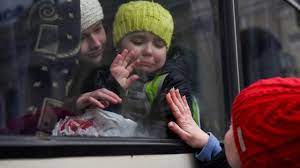
However, in comparison, any discomfort of my daily life is unable to match that of the citizens of Ukraine, and that’s the perspective I’m choosing to take as I pay at the pump. I am fortunate enough to be able to shift my choices and preferences and still have a comfortable existence. There are about 3.5 million people right now (and sadly that number grows by the minute) who would likely give anything to say the same.

Слава Україні!


Thanks for your thoughtful and caring response to this humanitarian crisis, and I’m not talking about inflation. I found this interview with author Timothy Snyder, a historian of Ukraine and Russia, informative and frightening but not without hope.
https://podcasts.apple.com/us/podcast/the-ezra-klein-show/id1548604447?i=1000554066715
LikeLike
I will for sure take a listen. Thank you for the comment Scott. It is breaking my heart and soul what is happening over there. I only wish I could do so much more.
LikeLike